
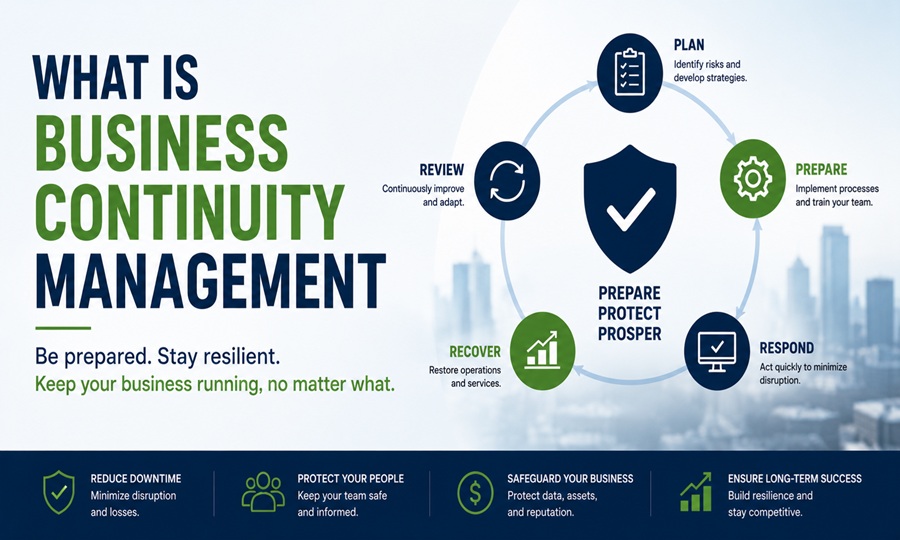
Most organizations spend their energy building capacity to grow. Fewer invest equally in their capacity to survive. Business continuity management is the discipline that addresses this gap. It is not a contingency plan filed in a drawer and forgotten. It is an active, ongoing management process that ensures an organization can continue to deliver its most critical functions during a disruption and recover fully once that disruption passes. In 2026, with downtime costs reaching $1 million to $3 million per hour for large organizations and 814 ransomware incidents recorded in December 2025 alone, the question for most businesses is no longer whether they need BCM but how rigorously they have built it.
The Formal Definition and What It Really Means
Business continuity management is defined by the International Glossary for Resiliency as a holistic management process that identifies potential threats to an organization and the impacts those threats might cause to business operations, and which provides a framework for building organizational resilience with the capability for an effective response that safeguards the interests of key stakeholders, the organization’s reputation, brand, and value-creating activities.
In plain terms, BCM is the work an organization does before a crisis so that when a crisis arrives, the response is not improvised but executed according to a tested plan with known owners, clear procedures, and rehearsed decision-making protocols. The distinction between having thought about what to do and having actually prepared to do it under pressure is where most BCM programs either deliver or fail.
It is also important to understand what BCM is not. It is not the same as disaster recovery, though disaster recovery is a component of it. Disaster recovery focuses specifically on restoring technology systems and data after a disruption. Business continuity management encompasses the full organizational picture, including crisis communications, workforce continuity, supply chain resilience, regulatory compliance during incidents, and the restoration of all critical operational functions, not just IT systems. As DRI International, one of the leading credentialing bodies in the field, describes it, BCM integrates emergency response, crisis management, disaster recovery, and organizational continuity into a single coherent discipline.
The Business Impact Analysis: Where BCM Actually Begins
Every competent BCM program is anchored in a Business Impact Analysis, which is the systematic process of identifying an organization’s critical functions, quantifying what it would cost if those functions were unavailable for varying lengths of time, and using those findings to drive every subsequent planning decision.
The BIA asks two foundational questions for each critical business activity. How long can the organization tolerate this function being unavailable before the impact becomes severe or irreversible? And how much data loss, measured in time, is the organization prepared to accept in a recovery scenario?
The answers to these questions produce two of the most important metrics in BCM. The Recovery Time Objective, or RTO, is the maximum duration within which a disrupted function must be restored. It drives decisions about infrastructure redundancy, recovery technology, and staffing arrangements. A payment processing function with an RTO of two hours requires fundamentally different recovery architecture than a reporting function with an RTO of 48 hours.
The Recovery Point Objective, or RPO, defines the maximum amount of data loss an organization can tolerate, expressed as a point in time. An RPO of 15 minutes means the organization requires data backups or replication at intervals no greater than 15 minutes. An RPO of 24 hours means a once-daily backup is sufficient. RPO directly determines backup frequency, data replication strategy, and storage infrastructure requirements.
A third metric that competent BIA practitioners use is the Maximum Tolerable Period of Disruption, which defines the outer boundary beyond which the organization’s viability would be irrevocably threatened. The RTO must always be set inside this boundary to ensure a meaningful safety margin. Together, these three metrics transform BCM from a qualitative conversation about risk into a quantified framework for resource allocation and recovery planning.
The ISO 22301 Standard: The Internationally Recognized Framework
For organizations that want to build BCM on a recognized, auditable foundation, ISO 22301 is the international standard for Business Continuity Management Systems. First published in 2012 and revised in 2019, it specifies the requirements for establishing, implementing, maintaining, and continually improving a management system that protects against, reduces the likelihood of, and ensures recovery from disruptive incidents.
As ISO’s official overview of the 22301 standard explains, the standard follows the Plan-Do-Check-Act cycle that is common across ISO management system standards, which means it is designed not as a static document but as an ongoing operational discipline that is continuously evaluated and improved. Organizations with ISO 22301 certification typically recover from disruptions 50 percent faster than those without structured BCM, and the standard saw 82.9 percent growth in certifications during 2020 as organizations recognized the need for tested resilience frameworks in the face of pandemic-scale disruption.
Certification to ISO 22301 requires an independent audit by an accredited certification body and demonstrates to customers, regulators, insurers, and partners that the organization’s BCM capability has been rigorously tested against international requirements. For organizations in regulated industries including financial services, healthcare, and critical infrastructure, ISO 22301 certification is increasingly expected rather than simply valued.
The Core Components of a BCM Program
A mature business continuity management program is built from several interconnected components that collectively ensure the organization can anticipate, withstand, and recover from a broad range of disruption scenarios.
Governance and policy is the foundation. An effective BCM program requires visible executive sponsorship, a clearly defined policy that establishes the program’s scope and objectives, and assigned accountability for BCM leadership across the organization. Without senior-level ownership, BCM programs consistently fail to receive the resources, testing rigor, and organizational attention they require to remain effective.
Risk assessment identifies the full landscape of threats that could disrupt critical operations and evaluates each on the basis of probability and potential impact. In 2026, the threat landscape includes cyberattacks, ransomware, supply chain failures, extreme weather events linked to climate change, geopolitical disruptions, and third-party dependency failures. Organizations that rely heavily on cloud providers, managed service providers, and SaaS platforms face a specific category of risk that has grown significantly in recent years: their RTO is frequently constrained not by their own recovery capability but by the recovery timelines of the external providers they depend on.
Business continuity plans and disaster recovery plans are the documented procedures that translate BCM strategy into operational response. A BCP typically covers workforce deployment, crisis communication protocols, alternate work locations, customer notification procedures, and the sequence of recovery activities for each critical function. A DRP covers the technical steps for restoring IT systems, applications, and data within the defined RTOs and RPOs.
Testing and exercising is the component that separates organizations with genuine resilience from those with impressive documentation. A plan that has never been tested is a hypothesis, not a capability. Effective BCM programs test their plans regularly through tabletop exercises, functional exercises where recovery procedures are actually executed in a controlled environment, and full-scale simulations that replicate real crisis conditions as closely as possible. Each test surfaces gaps that a document review would never reveal and builds the muscle memory that allows teams to respond effectively under the genuine pressure of a real event.
BCM in the Age of Cyber Threats
The integration of cybersecurity resilience into BCM is one of the most significant shifts in the discipline over the past several years, and it has fundamentally changed what a mature BCM program looks like in 2026.
Ransomware has emerged as one of the most operationally destructive threats facing organizations of all sizes. Unlike a natural disaster that damages physical infrastructure, ransomware can encrypt every critical system, database, and backup simultaneously if the organization’s recovery architecture has not been specifically designed to prevent it. Effective BCM in 2026 requires immutable backups stored in isolated environments that ransomware cannot reach, tested restoration procedures that have been validated end to end rather than assumed to work, and incident response protocols that integrate seamlessly with the broader BCM framework so that a cyber incident triggers a coordinated organizational response rather than a fragmented technical reaction.
The convergence of IT and operational technology in manufacturing, utilities, and critical infrastructure has also expanded the cyber resilience requirements of BCM significantly. A production facility where industrial control systems are networked needs BCM coverage that extends beyond office IT systems to encompass the specialized technology that runs physical operations.
The Cost of Operating Without BCM
The financial case for investing in business continuity management becomes clear when the costs of unpreparedness are examined honestly. Downtime costs for large organizations reach $1 million to $3 million per hour across direct revenue loss, recovery expenses, regulatory penalties, and customer compensation. For mid-sized organizations, the per-hour costs are lower in absolute terms but equally or more devastating as a proportion of annual revenue.
Beyond the direct financial impact, organizations that experience poorly managed disruptions face compounding reputational consequences that affect customer retention, partner relationships, and regulatory standing long after the operational incident is resolved. Customers who experience service failures during a disruption that could have been prevented or shortened by better planning do not always return. Regulators who observe inadequate incident response do not forget it at the next examination.
The organizations that treat BCM as a strategic investment rather than a compliance exercise discover that it delivers value well before any crisis occurs. Clear understanding of critical functions, defined recovery priorities, and tested response procedures create operational clarity and resource efficiency that benefit day-to-day management, not just crisis response.
Building BCM That Actually Works
The difference between BCM programs that produce genuine resilience and those that produce impressive documentation without operational substance comes down to a small number of consistently applied principles.
First, scope the program around what actually matters. BCM is most effective when it focuses deeply on the functions whose failure would genuinely threaten the organization’s viability rather than trying to cover every conceivable scenario at equal depth. A focused BIA that produces accurate RTO and RPO targets for the ten most critical functions is more valuable than a comprehensive document that treats all functions as equally important.
Second, test everything that matters. The value of every plan, procedure, and recovery technology is zero until it has been validated under realistic conditions. Organizations that test their BCM capabilities regularly and honestly, and that treat the gaps those tests reveal as improvements to be made rather than embarrassments to be minimized, build resilience that holds under real-world pressure.
Third, keep the program current. A BCM plan that accurately reflects the organization’s operations, systems, and risk landscape is a living document that requires ongoing maintenance as those things change. Annual reviews are a minimum standard. Organizations that change rapidly need more frequent updates.
Business continuity management is not about imagining the worst. It is about ensuring that when difficult things happen, as they inevitably do, the organization is ready to respond with competence, protect what matters most, and emerge from disruption with its reputation and operational capability intact.