
The nonprofit sector is navigating one of its most complex operating environments in recent memory. National charitable giving exceeded $592 billion in 2025 according to Giving USA, yet 81 percent of nonprofits reported struggling to raise enough funds to cover their full costs in the same year. Government funding disruptions affected one third of organizations in the first half of 2025, and donor retention rates have dropped to 42.6 percent overall. Meanwhile, 68 percent of nonprofits expect demand for their services to increase in 2026 while only 31 percent say they are actually expanding the number of people they serve.
In that environment, a nonprofit business plan is not optional paperwork. It is the strategic foundation that separates organizations that grow their impact through clarity and discipline from those that struggle year after year without a coherent plan for sustainability. Whether you are launching a new organization, seeking a major grant, approaching a foundation, or trying to get your board aligned on a three-year direction, a well-written nonprofit business plan is the document that makes those conversations possible.
What a Nonprofit Business Plan Is and Why It Differs From a For-Profit Plan
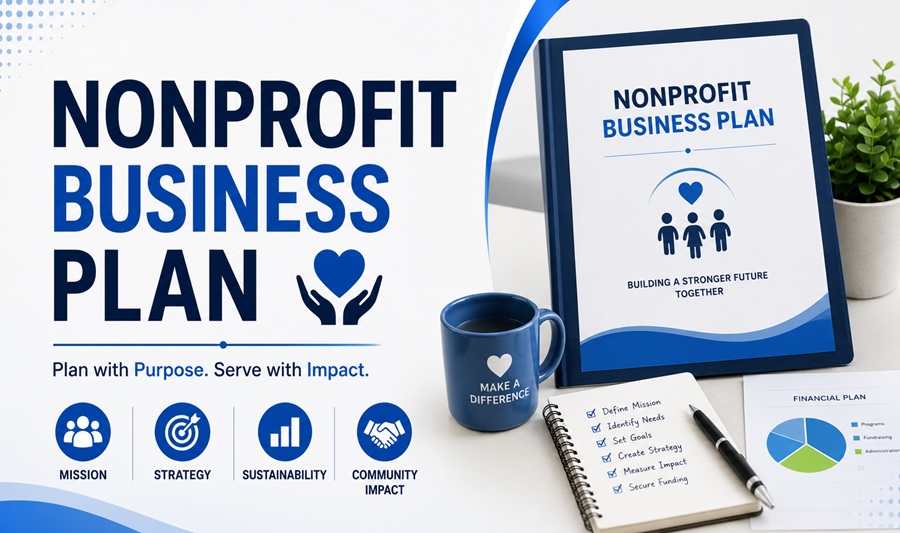
A nonprofit business plan is a formal document that defines an organization’s mission, the community it serves, the programs it operates, how it is structured and governed, how it will be funded, and what financial and impact targets it intends to achieve over the planning period. It serves as a strategic roadmap for leadership, a credibility document for funders, and an accountability framework for the board.
What makes a nonprofit business plan distinct from a for-profit equivalent is the nature of success it is designed to achieve. A for-profit business plan is ultimately built around profit generation and return to shareholders. A nonprofit business plan is built around mission delivery and community impact, and the financial planning within it exists to support that mission rather than to be the primary objective.
This distinction has practical implications for every section of the plan. Where a for-profit plan emphasizes market share and revenue growth, a nonprofit plan emphasizes the breadth and depth of the population served and the measurable changes achieved in their lives or circumstances. Where a for-profit plan builds toward investor returns, a nonprofit plan builds toward a diversified, sustainable funding base that ensures the mission can continue. Financial sustainability is critically important in a nonprofit business plan, but it is always framed as a means to mission rather than an end in itself.
The Core Components of a Nonprofit Business Plan
While there is no single required format, every credible nonprofit business plan includes a set of foundational sections that together provide a complete picture of how the organization operates and where it is headed.
The executive summary opens the document and must do considerable work in a small amount of space. It introduces the organization’s mission, describes the problem being addressed, summarizes the programs or services offered, outlines the financial situation and funding strategy, and conveys the organizational vision in terms compelling enough to motivate a reader to engage with the full document. Because many funders and board members will read the executive summary first and may only skim the rest, it needs to stand alone as a concise, persuasive overview that makes the case for the organization’s value and viability.
The organization overview provides the historical and structural context that grounds everything else in the plan. This section covers the organization’s founding story, its legal structure and tax-exempt status under the IRS, its current stage of development, and the governance framework that guides its decision-making. The board composition, with brief profiles of board members and their relevant expertise, belongs here and matters significantly to funders who view board quality as a direct indicator of organizational health.
The problem statement and mission section articulates the specific community need the organization exists to address, supported by data that validates both the scale of the problem and the gap in existing solutions. A strong problem statement is specific enough to be credible, compelling enough to motivate action, and connected clearly to the mission statement that follows it. Vague language about wanting to help people or improve communities signals a lack of strategic clarity that experienced funders will notice immediately.
Programs, Services, and Theory of Change
The programs and services section is where the plan moves from describing the problem to describing the solution, and it is one of the sections most carefully evaluated by grant-making organizations.
Each program or service offering should be described with enough specificity that a reader unfamiliar with the organization can understand exactly what is provided, to whom, through what delivery mechanism, at what scale, and with what staffed or volunteer resources. Generic descriptions of providing education or delivering services without specifics about curriculum, caseloads, geographic reach, or delivery model raise more questions than they answer.
Theory of change is a concept that has become increasingly central to how sophisticated funders evaluate nonprofit programs, and it deserves explicit attention in any business plan written for a grant-seeking context. A theory of change is the logical framework that connects the organization’s activities to the outcomes it expects to achieve, and then connects those outcomes to the broader social change the organization ultimately seeks. It answers the question: if we do X, it will lead to Y, which will contribute to Z.
Funders who understand program evaluation are not simply asking what you do. They are asking how you know it works, and a theory of change articulates the reasoning that connects program activities to the impact claims the organization makes.
Market Analysis for Nonprofits
The market analysis section requires a different framing for nonprofits than the competitive analysis a for-profit business plan would include, though both involve understanding the landscape in which the organization operates.
For a nonprofit, market analysis covers the demographic and geographic profile of the population served, the scale of the need being addressed, the existing organizations working in the same space, and the organization’s specific positioning relative to those others. This is not about identifying competitors in the traditional sense. It is about demonstrating that the organization understands its community deeply, knows what else exists to serve that community, and has a clear rationale for why its approach adds value rather than duplicating what already exists.
As the National Council of Nonprofits explains in its guidance on nonprofit planning, effective nonprofit planning is grounded in an honest assessment of both the external environment and the organization’s internal strengths and limitations. A market analysis that honestly identifies gaps in current service delivery, documents unmet community need with real data, and positions the organization as a distinctive and complementary contributor to the broader ecosystem will be far more persuasive to funders than one that simply asserts the organization is unique and needed without evidence.
Financial Planning: The Section That Makes or Breaks Funding Conversations
Financial planning is the section of a nonprofit business plan that receives the most scrutiny from institutional funders, and where many organizations fall short by being either overly optimistic or insufficiently detailed.
The financial section should include a current operating budget that accurately reflects actual revenues and expenses, multi-year financial projections covering at least three years, a cash flow analysis that identifies periods of expected shortfall and the strategies for addressing them, and a funding diversification plan that explains how the organization intends to reduce concentration risk across its revenue sources.
The funding diversification issue deserves specific attention in 2026. With 45 percent of nonprofits expecting declines in federal or national government grants and 30 percent anticipating state grant reductions, organizations that are heavily dependent on government funding are facing a structural vulnerability that funders and board members are acutely aware of. A business plan that acknowledges this risk and presents a credible strategy for diversifying toward individual major gifts, earned revenue, or corporate partnerships is far more compelling than one that simply projects continued government funding at current levels.
Individual giving is where confidence is actually strongest. The CCS Fundraising Philanthropy Pulse survey found that 57 percent of organizations expect growth in major gifts, 52 percent anticipate growth in mid-level gifts, and 49 percent forecast growth through annual appeals in 2026. A financial plan that shifts investment toward individual donor development and demonstrates a pipeline of major gift prospects is well-aligned with where actual fundraising momentum exists in the current environment.
The financial section should also address the organization’s operating reserves position. An organization with three to six months of operating expenses in unrestricted reserves is in a fundamentally different risk profile from one operating paycheck to paycheck, and demonstrating awareness of and progress toward an adequate reserves target signals financial maturity to sophisticated funders.
Operational Plan and Staffing
The operational plan translates the program strategy and financial projections into a concrete description of how the organization will function day to day. It covers staffing structure with roles, responsibilities, and compensation levels, facilities and technology needs, key partnerships and subcontracting arrangements, and the systems and processes that govern program delivery and administrative functions.
Staffing decisions deserve particular attention given the workforce challenges facing the sector. The Center for Effective Philanthropy’s State of Nonprofits 2026 report found that 95 percent of nonprofit CEOs express concern about burnout and only 45 percent of employees plan to stay in their current roles. An operational plan that acknowledges realistic turnover risk, includes investment in staff development and retention, and demonstrates competitive compensation within the constraints of available funding is more credible than one that assumes perfect staff continuity at below-market wages.
Technology infrastructure has become a meaningful component of operational planning for nonprofits in 2026. Constituent relationship management systems, donor management platforms, program data tracking tools, and financial management software collectively enable the kind of data-driven decision-making that major funders increasingly expect and that the BPM 2026 Nonprofit Sector Outlook identifies as a critical differentiator between organizations that thrive and those that struggle.
Measurement and Impact Reporting
A section on measurement, evaluation, and impact reporting has become a near-universal expectation in grant applications and is a meaningful signal of organizational maturity in any business plan context.
This section should define the specific outcomes the organization intends to achieve, describe how those outcomes will be measured, and explain how the data will be used to improve programs over time. The distinction between outputs and outcomes matters here. Outputs are the activities and products of the work: number of meals served, classes held, or clients counseled. Outcomes are the changes that result from those activities: improved food security, increased academic achievement, or reduced rates of substance use. Funders have become increasingly sophisticated in expecting outcome data rather than output counts, and a business plan that makes this distinction explicitly demonstrates evaluation literacy that builds funder confidence.
Making the Plan Work Beyond the Document
The most useful nonprofit business plan is not the one that looks most impressive as a document. It is the one that gets used. Plans that sit in a shared drive referenced only when a grant application requires it have failed at their core purpose regardless of how well written they are.
The organizations that derive the most value from their business plans treat them as living operational tools. They review them at board meetings, update them when circumstances change, use them to evaluate whether proposed new programs or partnerships align with the stated strategy, and build their annual budgeting and staffing decisions from the goals and priorities the plan articulates. That kind of disciplined use of a strategic document is what distinguishes organizations with genuine direction from those that are simply reacting to whatever opportunities and pressures arrive each month.
The nonprofit sector in 2026 is operating under real stress, but the organizations that enter this period with clear plans, diversified funding strategies, and honest assessments of their operational realities are better positioned to sustain their missions than those that are simply hoping the environment improves. A thoughtful, well-researched nonprofit business plan is one of the most practical things a leadership team can produce to strengthen that position.
This article is for informational purposes only and does not constitute legal, financial, or tax advice. Please consult qualified professionals for guidance specific to your organization.